
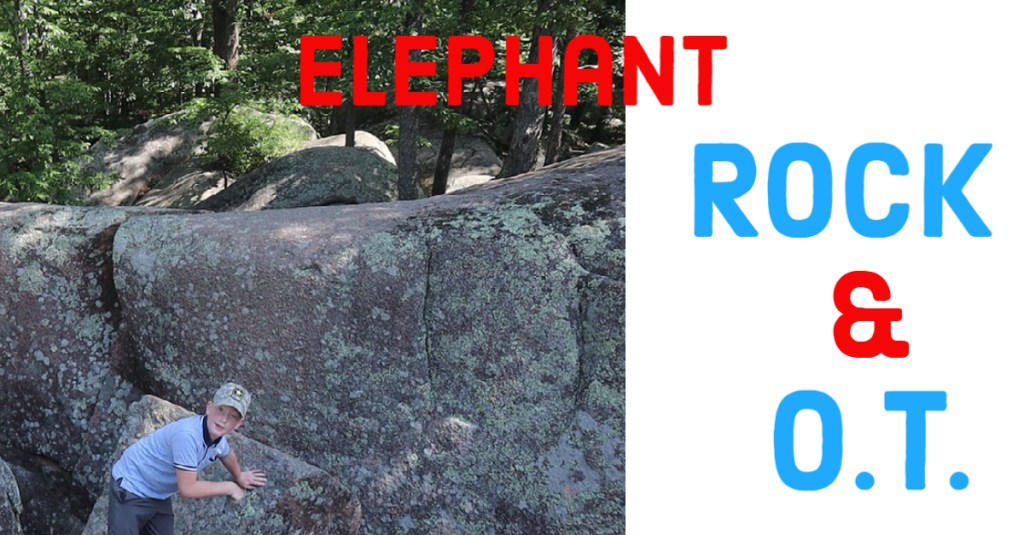
Christian and Nana are exploring again, and they go to Elephant Rock in Missouri. Elephant Rock has climbing, hiking, viewing, and picnicking. Elephant Rock was excited to see it for the first time. We had fun climbing and jumping around on the rocks. We started at the “The Maze,” a 100-foot (30.48 meters) section of scattered boulders. The climb was terrifying for Christian at first, but he did overcome his fear. When the boys below him yelled, he also had a moment of alarm; he bent down to cover his ears and regroup. He ran into the wooded area and was able to do a little ‘push and pull exercises. He also found a log to walk across (vestibular exercises). We did find a large rock that looked like a duck. We also saw a rock that liked like the rock from Lion King rock; however, Christian was afraid to get up on it because of the water on the other side. It was the quarry that was flooded with all the rain this year. Chrisitan and a friend began playing monkey and calling each other as they ran around the parking area at Elephant Rock.
According to https://en.wikipedia.org/wiki/Elephant_Rocks_State_Park, “The Elephant Rocks, ” Elephant Rocks State Park is named, is a pile of residual boulders of weathered Graniteville Granite. It is a medium- to coarse-grained, muscovite-biotite alkali granite that, on average, consists of 55 percent alkali feldspar, 40 percent quartz, and less than 5 percent mafic minerals. The Graniteville Granite is a pluton formed 1.4 billion years ago in the Proterozoic by the cooling of magma that intruded into the volcanic strata and country rock associated with a collapsed caldera. Nearly vertical fractures formed in the stone as it cooled, and the uplift of the granite enhanced the fracturing. Eventually, the overlying strata were removed through erosion, exposing the granite pluton. Before it was exposed, groundwater weathered the granite along fracture joints, creating relatively solid altered granite cornerstones embedded within friable saprolite.
A surface runoff later eroded the saprolite that once surrounded
the cornerstones and left, what are now locally called elephant rocks as boulders perched on the ground surface.[6] The reddish or pink granite has been quarried in this area since 1869, and two abandoned granite quarries are within the park. These and others nearby have provided red architectural granite for buildings in states from Massachusetts to California, but most particularly in St. Louis, including stone for St. Louis City Hall and the piers of the Eads Bridge. Stones unsuitable for architectural use were made into shoebox-sized paving stones used on the streets of St. Louis and on its wharf on the Mississippi River. Stone quarried in the area currently is used for mortuary monuments and is known commercially as Missouri Red monument stone.”
 Kid from Missouri travels
Leave a comment